Poisson processes and sigmoids
Michael Barkasi
July 2, 2026 (v2.4)
tutorial_Poisson.RmdPoisson processes
Suppose you want to model some process which generates tokens of a certain type over space. For example, the cells in your body generate RNA molecules through gene transcription and rabbits in a forest generate offspring through reproduction. If every instance of the process (e.g., every cell, or every rabbit) in the same place x produces tokens at the same rate \lambda, then the number y of tokens generated in a given region will follow a Poisson distribution: y\sim \text{Pois}(n\lambda) with rate parameter equal to n\lambda, for n the number of process instances in the region.
Real cases of distributed Poisson processes rarely have instances with identical rates. For example, rabbits will reproduce at different rates depending on factors like age, and cells will transcribe genes at different rates depending on their type and state. This variation is often gamma-distributed, such that if \lambda is the mean process rate at x, then individual process instances will have rate \Lambda drawn from a gamma distribution: \Lambda\sim \text{Gam}(\lambda, \sigma_\gamma^2) with expected value \lambda and variance \sigma_\gamma^2.
Simulating data
Let’s simulate a Poisson process with gamma-distributed variation with instances spread over a one-dimensional space x. The space will be divided into 100 bins:
n_bins <- 100
x      <- seq(1, n_bins)
We will randomly distribute 10,000 process instances across the space, for an average of 100 instances per bin. The variable holding these positions will be called bin:
set.seed(123) # for reproducibility
n_instances <- 10000
bin         <- sample(x, n_instances, replace = TRUE)
Now suppose that the space is divided into four equal-sized blocks, each with a different constant process rate \lambda, and suppose there is a constant variance \sigma_\gamma^2 = 2 across the entire space. Suppose these rates \lambda are 1, 5, 2, and 7. We can represent this as a vector lambda of length 100, with each block’s rate repeated twenty-five times. The process counts can be simulated for each instance by pulling individual process rates from a gamma distribution and then drawing counts from a Poisson distribution with those rates:
lambda    <- rep(c(1, 5, 2, 7), each = length(x)/4)
var_gamma <- 2
process_lambda <- rgamma(
    n_instances,
    shape = lambda[bin]^2/var_gamma,
    rate  = lambda[bin]  /var_gamma
  )
count <- rpois(n_instances, process_lambda)
The variable count is a vector of length 10,000 holding the observed count for each process instance. These simulated process counts can be combined into a dataframe called countdata:
countdata <- data.frame(bin, count)
print(head(countdata))
## bin count
## 1 31 3
## 2 79 8
## 3 51 0
## 4 14 3
## 5 67 3
## 6 42 7This data frame can be used to plot the counts as a function of space:
ggplot2::ggplot(countdata, ggplot2::aes(x = bin, y = count)) +
  ggplot2::geom_jitter(height = 0, width = 0.5, alpha = 0.1) +
  ggplot2::labs(
    title = "Simulated Poisson process",
    x     = "Spatial bin",
    y     = "Process count"
  ) +
  ggplot2::theme_minimal() +
  ggplot2::theme(
    panel.background = ggplot2::element_rect(fill = "white", colour = NA),
    plot.background  = ggplot2::element_rect(fill = "white", colour = NA)
  )
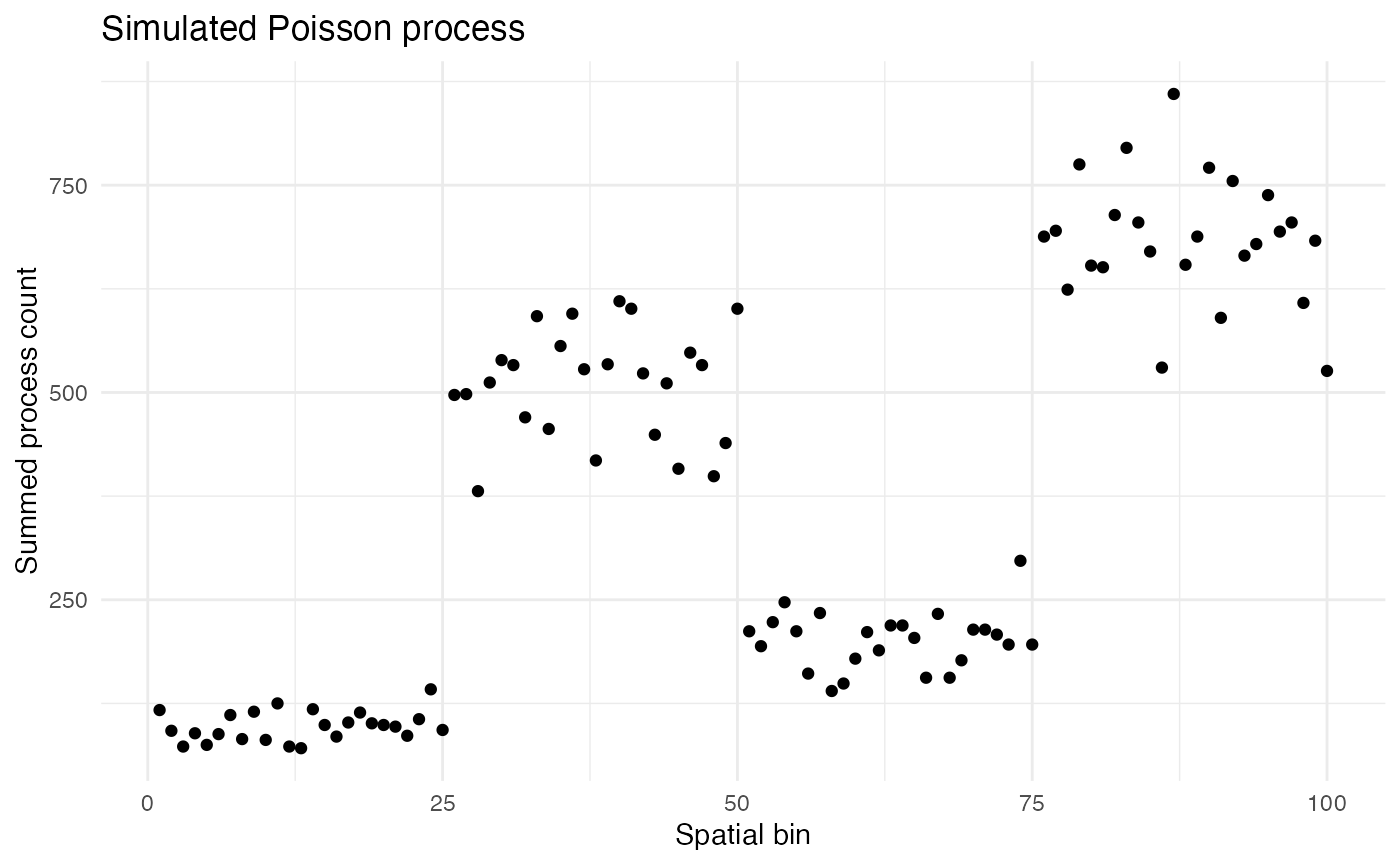
As Poisson distributions are preserved under addition, the counts for each bin can be summed while maintaining a Poisson distribution.
summed_counts <- aggregate(count ~ bin, data = countdata, sum)
ggplot2::ggplot(summed_counts, ggplot2::aes(x = bin, y = count)) +
  ggplot2::geom_point() +
  ggplot2::labs(
    title = "Simulated Poisson process",
    x     = "Spatial bin",
    y     = "Summed process count"
  ) +
  ggplot2::theme_minimal() +
  ggplot2::theme(
    panel.background = ggplot2::element_rect(fill = "white", colour = NA),
    plot.background  = ggplot2::element_rect(fill = "white", colour = NA)
  )
Modeling with sigmoids
Wisps are mathematical models for describing gamma-distributed Poisson processes. The parameters used to create the dataframe countdata can be recovered using a wisp. A wisp model is fit in two steps.
The first step is to find transition points p in count rate by looking for outliers in the ratio between the likelihood of the neighborhood around x having a constant rate and the likelihood of each side of the neighborhood around x having different rates (LRO change-point detection). If there are n such transition points p=\langle p_1,\ldots,p_n\rangle, then a specific variety of sigmoid, the logistic function: \psi(x,r,s) = \frac{r}{1 + \exp({sx})} can be used to model the rate \lambda across space by combining n such sigmoids into a wisp function: \Psi(x,r,s,p) = r_1 + \sum_{i=1}^n \psi(x - p_i, r_{i+1} - r_{i}, -s_i) with rate parameters r=\langle r_1,\ldots,r_{n+1}\rangle and slope-scale parameters s=\langle s_1,\ldots,s_{n}\rangle.
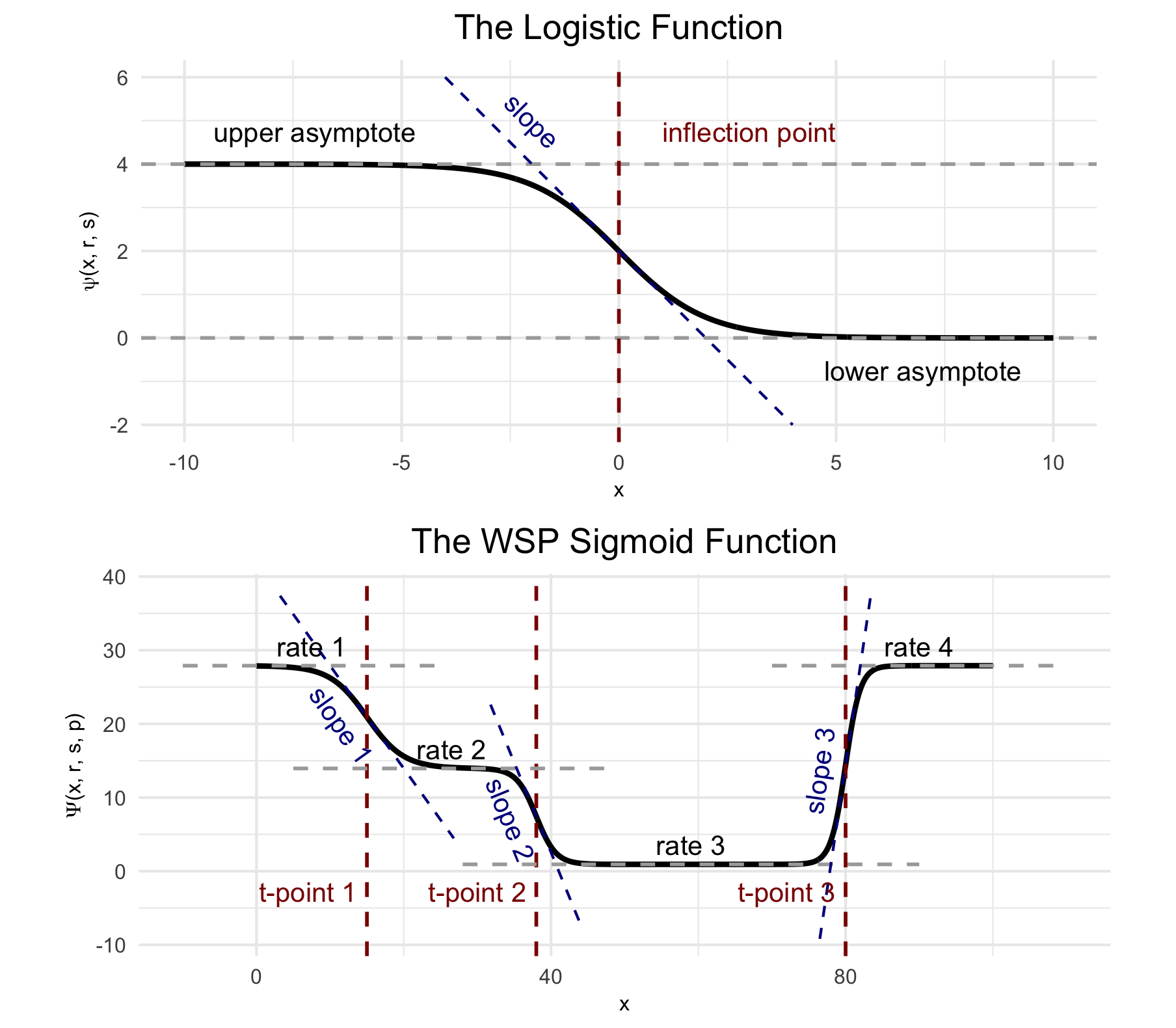
(Top) The logistic function, used to model a single change point in gene expression. (Bottom) The wisp poly-sigmoid function, built from three logistic components, representing three change points.
The second is to use gradient-based optimization or MCMC to find the parameters r, s and p which maximize the likelihood of the log transform \log(y+1) of countdata$count.
For this demonstration, the data in countdata has been explicitly constructed with the statistical structure captured by wisp using known parameters r and p. Thus, fitting a wisp model to countdata should recover those parameters.1
library(wispack, quietly = TRUE)
model <- wisp(
    countdata,
    fit_only       = TRUE,
    model.settings = list(LRO_cost = "none"),
    plot.settings  = list(CI_style = FALSE)
  )
##
## Parsing data and settings for wisp model
## ----------------------------------------
##
## Model settings:
## buffer_factor: 0.05
## ctol: 1e-06
## max_penalty_at_distance_factor: 0.01
## LRO_cost: none
## LROcutoff: 2
## LROwindow_factor: 1.25
## rise_threshold_factor: 0.8
## max_evals: 1000
## rng_seed: 42
## warp_precision: 1e-07
## round_none: TRUE
## trtKO: none
## max_bin: 0
## inf_warp: 450359962.73705
##
## Plot settings:
## print.plots: TRUE
## dim.bounds:
## log.scale: FALSE
## splitting_factor:
## CI_style: FALSE
## splitting_factor_colors: 120, 240
## label_size: 5.5
## title_size: 20
## axis_size: 12
## legend_size: 10
## count_size: 1.5
## count_jitter: 0.5
## count.alpha.ran: 0.25
## count.alpha.none: 0.25
## pred.alpha.ran: 0.9
## pred.alpha.none: 1
##
## Variable dictionary:
## count: count
## bin: bin
## context: context
## species: species
## ran: ran
## timeseries: timeseries
## fixedeffects:
##
## Parsed data (head only):
## ------------------------------
## count bin context species ran
## 1 3 31 context species ran
## 2 8 79 context species ran
## 3 0 51 context species ran
## 4 3 14 context species ran
## 5 3 67 context species ran
## 6 7 42 context species ran
## ----
##
## Initializing Cpp (wspc) model
## ----------------------------------------
## Context grouping levels: "context"
## Species grouping levels: "species"
## Random-effect grouping levels: "ran"
##
## Infinity handling:
## machine epsilon: (eps_): 2.22045e-16
## pseudo-infinity (inf_): 1e+100
## warp_precision: 1e-07
## implied pseudo-infinity for unbounded warp (inf_warp): 4.5036e+08
##
## Extracting variables and data information:
## Max bin: 100
## No fixed effects detected.
## No time series detected.
## Created treatment levels: "ref"
## Total rows in summed count data table: 100
## Number of rows with unique model components: 1
##
## Running LRO change-point detection and setting initial parameters
## ----------------------------------------
##
## Estimated change points
## Estimated initial parameters
## Number of parameters: 10
## Size of boundary vector: 11
##
## Fitting model to data
## ----------------------------------------
##
## Initial nll: 183.846
## Initial nll with penalty: 185.518
## Initial min boundary distance: 0.25
## Final nll: 183.287
## Final nll with penalty: 184.444
## Final min boundary distance: 4.68519
## Number of evaluations: 35
##
## Making rate-count plots...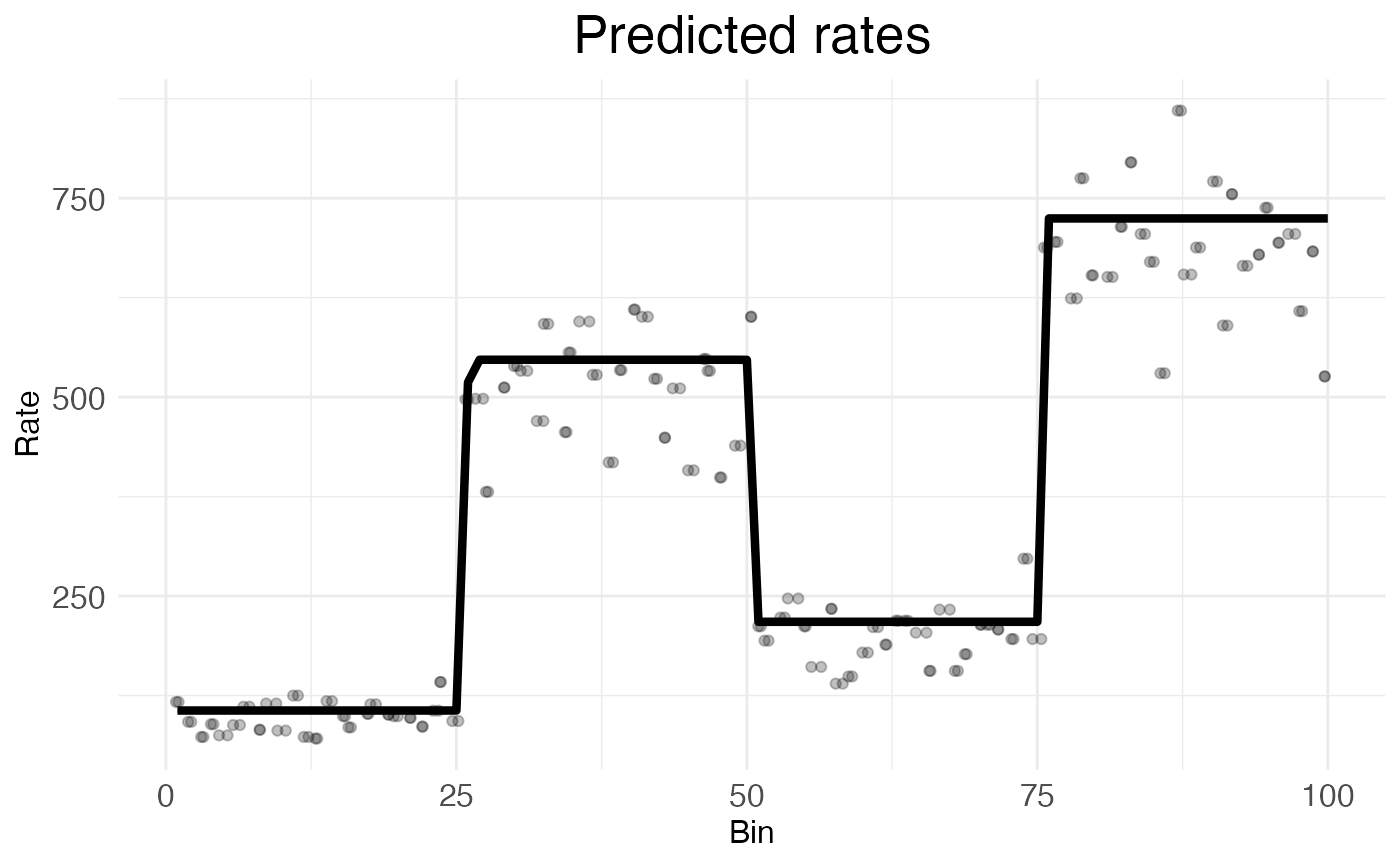
The above plot makes visually clear that the wisp is a good fit for the data. The wisp function has identified the three rate-transition points dividing the data into four equal-sized blocks and, within each block, has identified a rate parameter which visually seems to land in the middle of the data.
The recovered parameters can also be extracted as numerical values:
param_names <- names(model$fitted.parameters)
est_param   <- round(model$fitted.parameters, 3)
for (param_type in c("Rt", "tslope", "tpoint")) {
  cat(
  "\nRecovered", param_type, "parameters:",
  paste0(
      est_param[grepl(param_type, param_names)],
      collapse = ", "
    )
  )
}
##
## Recovered Rt parameters: 4.675, 6.306, 5.388, 6.587
## Recovered tslope parameters: 26.572, 14.986, 27.099
## Recovered tpoint parameters: 25.85, 50.452, 75.832It is immediately clear from the three tpoint parameters (i.e., p) that wisp has recovered the transition points at bins 25, 50, and 75. However, at first glance, the rates (Rt) look off. This is because wisp has predicted the log transform of the sum of the rates. To recover the original rates of 1, 5, 2, and 7, we need to exponentiate the recovered rates, subtract 1, and divide by the mean number of tokens per bin within the block.
tokens_per_bin <- rep(NA, n_bins)
for (b in 1:n_bins) tokens_per_bin[b] <- sum(countdata$bin == b)
for (block in 1:4) {
  start_bin      <- (block - 1) * 25 + 1
  end_bin        <- block * 25
  mean_tokens    <- mean(tokens_per_bin[start_bin:end_bin])
  rate_param     <- model$fitted.parameters[block]
  recovered_rate <- (exp(rate_param) - 1) / mean_tokens
  cat(
    paste0(
        "\nBlock ", block,
        " recovered rate: ", round(recovered_rate, 3)
      )
    )
}
##
## Block 1 recovered rate: 1.059
## Block 2 recovered rate: 5.412
## Block 3 recovered rate: 2.16
## Block 4 recovered rate: 7.407Thus, wisp indeed works well for modeling gamma-distributed Poisson processes!